About the service
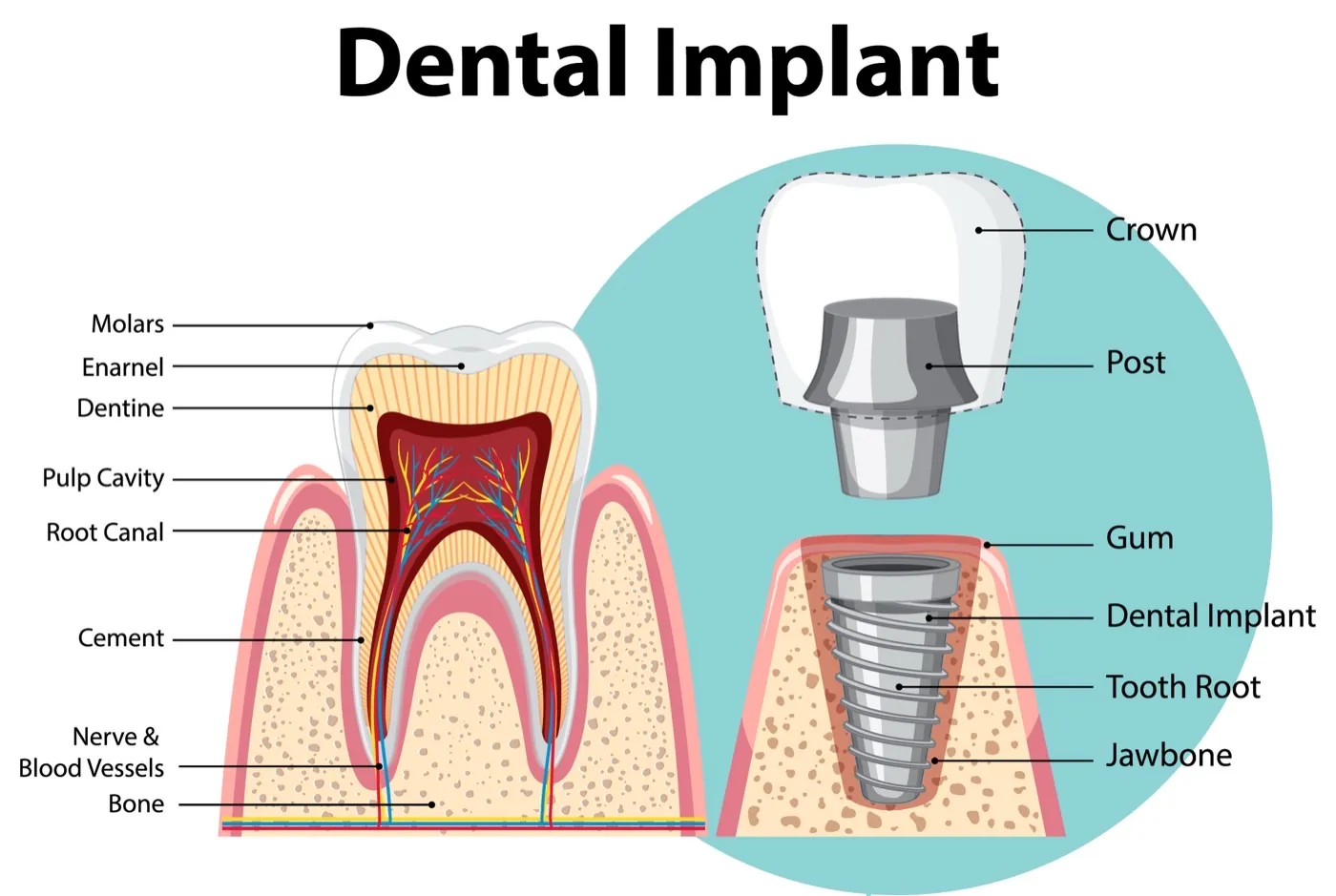
A dental implant is an artificial tooth root: a small metal post placed surgically in the jawbone, under the gum, to support replacement teeth. The Ontario Dental Association (ODA) explains that the tooth or teeth are attached a few months later, once the implant has fused with the bone around it.
Implants can hold a single tooth, anchor a fixed bridge when several or all teeth are being replaced, or secure a denture that attaches to or fits over them.
When is a dental implant recommended?
The ODA says missing teeth should be replaced, by whatever method, so you can chew properly, to stop other teeth from shifting, to keep the jawbone level at the site, and for appearance.
The Royal College of Dental Surgeons of Ontario (RCDSO), which regulates the province's dentists, says in its implant guideline that a dentist needs a sound reason, with a clear benefit to you, to recommend an implant over other options.
Who can have a dental implant?
Implants do not suit everyone. The RCDSO says proper patient selection is essential, considering your medical suitability, the quality and amount of bone at the site, the health of the gums around your remaining teeth, and your ability to keep your mouth clean.
Conditions that can impair healing and the implant's integration with the bone, such as a history of smoking, bisphosphonate medications, auto-immune disorders or uncontrolled diabetes, must be identified before surgery. The ODA notes that smokers can be poor candidates for implants.
What happens before implant surgery?
Under the RCDSO guideline, treatment starts with an evaluation that includes complete medical and dental histories (including what you expect from treatment), an examination inside and outside your mouth, and X-rays of the site. Three-dimensional imaging such as a CT scan may be added where the anatomy is challenging.
What should your dentist explain before you agree?
The guideline says the consent discussion should cover your diagnosis, why an implant is proposed, its benefits and risks, the alternatives (including options without implants), the cost and length of treatment, the after-effects of surgery, the care needed afterwards, the likely outlook and lifespan, and your own part in its long-term success. You should also be told the likely consequences of not having treatment.
You must have time to consider this and get answers to your questions. The ODA says you can always seek a second opinion, though you will likely pay for that examination.
What happens during implant treatment?
The Canadian Dental Association (CDA) describes two stages. First, the implant is placed in the jawbone under the gum and the gum is stitched closed; the implant then bonds with the bone as it heals, which can take several months. Next, a post called an abutment is attached to connect the replacement tooth. In some cases both stages are done at once.
Under the RCDSO guideline, you are seen again to confirm the implant has joined the bone before the tooth is made, and your plan should include a temporary replacement in the meantime, such as a removable one or, in appropriate cases, a temporary tooth attached to the implant when it is placed.
How many visits does a dental implant take?
Treatment takes months, and the CDA says several visits may be needed. The RCDSO guideline describes a healing check, usually within a week or two of surgery; a follow-up within a few days to weeks of the final tooth being fitted; and a visit within a year, with X-rays of the bone around the implant.
Does implant surgery hurt?
Some pain afterwards is expected. The RCDSO lists pain, bleeding, swelling and bruising as expected after-effects of implant surgery, which the CDA classes as oral surgery. The CDA's general advice after minor oral surgery is that pain may be at its worst in the first 24 to 48 hours and soreness may last 3 to 5 days, though discomfort differs from person to person.
The RCDSO guideline says that when sedation or general anaesthesia is being considered for implant surgery, the recommendation must take into account your medical status, the extent of the planned surgery and your preference.
What should you do after implant surgery?
Follow your dentist's post-operative instructions and keep your follow-up appointment. The same CDA advice says swelling may appear in the first 24 hours and last 5 to 7 days, and that alcohol and tobacco should be avoided for the first 2 weeks because they hinder clotting, raise the risk of infection and delay healing.
When should you call the clinic?
The CDA advises calling your dentist without delay if, after oral surgery, you are still bleeding a lot four or more hours later, are vomiting or feel you will, have a fever, have pain that has not improved after a full day, or have swelling that is still getting worse after two days. During opening hours, call Ur Dental at (416) 222 - 0606.
How do you care for a dental implant?
The CDA says an implant needs careful brushing and flossing, like a natural tooth, and that your dentist will show you the proper technique. It also notes that an implant is not as strong as a natural tooth. The RCDSO guideline says maintenance visits are set to suit your case and may be combined with your regular check-ups.
What are the risks of dental implants?
Separately from the expected after-effects above, the CDA lists possible complications that it describes as rare: bleeding, infection, numbness, and injury to nearby muscles or the sinus cavity. In some cases the implant does not bond to the bone, a risk your dentist should explain before you agree.
Where the remedy for a complication is unpredictable or complex, the RCDSO guideline says retreatment should be considered, which may mean removing the implant, replacing the teeth it supports, or both.
What are the alternatives to a dental implant?
The ODA describes several options for replacing lost teeth: dentures, full or partial depending on how many teeth are missing; a bridge, a non-surgical option of false teeth attached to the natural teeth around the gap; and an implant, which is a surgical procedure.
For a gap between healthy teeth, the CDA notes that a single implant does not require the teeth on either side to be filed down for crowns, as a traditional bridge does.
Who places dental implants, and when is a referral made?
Implant dentistry is not a recognized dental specialty in Ontario, so no dentist may describe themselves as an implant specialist. The RCDSO guideline says that in straightforward cases the surgery can be provided by an appropriately trained dentist. In complex cases, for example those that may need significant bone or sinus grafting, it should be provided by an oral and maxillofacial surgeon, a periodontist or a dentist with further surgical training and extensive experience, so your dentist may refer you.
The ODA notes that you can also contact a specialist yourself, and the RCDSO says you can expect your dentist to be honest about their qualifications and skills.
How are fees for dental implants set?
Each dentist sets their own fees, which reflect factors such as the complexity of the treatment and the time it takes. The ODA publishes an annual Suggested Fee Guide that dentists are not required to follow, and the RCDSO says a dentist must tell you if they intend to charge more than it.
Before treatment starts, your dentist must tell you the expected cost, any additional costs that may arise and relevant insurance information. Estimates should include materials and laboratory fees at cost where they apply.
The CDA notes that implants can cost more than other replacement teeth and might not be covered by a dental plan.
Dental Implants: common questions
A dental implant is an artificial root for a replacement tooth: a small metal post put into the jawbone, beneath the gum, by surgery. The Ontario Dental Association explains that the implant first has to fuse to the surrounding bone, which takes a few months, before the replacement tooth or teeth are attached. Besides replacing one tooth, implants can support a fixed bridge or hold a denture in place.
It takes months rather than a single appointment. The Ontario Dental Association says the replacement tooth is attached a few months after the implant is placed, once it has fused to the bone, and the Canadian Dental Association says healing can take several months and several visits may be needed. Your dentist should discuss how long your own treatment is expected to take before you agree to it.
You can expect some pain after the surgery, since placing an implant is oral surgery. The Royal College of Dental Surgeons of Ontario says your dentist should talk with you, before you consent, about the after-effects to expect: pain, bleeding, swelling and bruising. For minor oral surgery in general, the Canadian Dental Association says some soreness may continue for 3 to 5 days, with pain possibly peaking over the first 24 to 48 hours, and the amount of discomfort is different for each person.
Not everyone is; the answer comes from an evaluation that should include your medical and dental history, an examination of your mouth and X-rays of the proposed implant site. The Royal College of Dental Surgeons of Ontario says proper patient selection is essential, and that a smoking history, bisphosphonate medications, auto-immune disorders and uncontrolled diabetes may impair healing and the way the implant integrates with the bone. If your jawbone has shrunk, the Canadian Dental Association says a bone graft may be able to build it up.
Either may, depending on the case. Under the Royal College of Dental Surgeons of Ontario's implant guideline, a suitably trained dentist can do the surgery when the case is straightforward; complex cases, for example ones that may need significant bone or sinus grafting, should go to an oral and maxillofacial surgeon, a periodontist, or a dentist who has completed additional surgical training and has extensive experience, and in that case your dentist may refer you. There is no recognized implant specialty in Ontario, so no dentist may present themselves as an implant specialist.
Beyond the expected after-effects of surgery, the Canadian Dental Association names infection, numbness, bleeding and injury to the sinus cavity or nearby muscles as possible complications, which it calls rare, and in some cases an implant is not successful because it did not bond with the bone. Your dentist should explain these risks before you agree. After oral surgery, the Canadian Dental Association advises calling your dentist right away if heavy bleeding continues four or more hours later, if you are vomiting or feel you are about to, if you have a fever, if pain is no better after a full day, or if swelling is still increasing after two days.
Your dentist should discuss the likely outlook and lifespan of your own implant treatment with you before you agree, along with your responsibility for its long-term success. The Canadian Dental Association advises brushing and flossing an implant carefully, pointing out that it is weaker than a natural tooth. The Royal College of Dental Surgeons of Ontario's guideline calls for a visit within a year of the final tooth being fitted, with X-rays to check the bone around the implant, and then maintenance visits suited to your case.
Dentists set their own fees, based on things such as how complex the treatment is, how long it takes and the materials used, and you must be told the expected cost before treatment begins. The Ontario Dental Association publishes a Suggested Fee Guide that dentists do not have to follow, and the Royal College of Dental Surgeons of Ontario requires a dentist who plans to charge above the Guide to tell you so. Implants might not be covered by your dental plan; your dentist can send the plan a pre-treatment form, and the predetermination that comes back shows what is covered but is not a promise of payment.
Visiting Ur Dental in North York
Ur Dental is at 6239 Bathurst Street, at Bathurst and Steeles. On-site parking is available.
Hours: Tuesday to Friday 10 a.m. to 6 p.m., Saturday and Sunday 9 a.m. to 5 p.m., closed Monday.
Book an AppointmentSources
- Ontario Dental Association: Cosmetic Dentistry
- Ontario Dental Association: Tooth Loss
- Ontario Dental Association: Smoking, Vaping and Marijuana
- Ontario Dental Association: Your Dental Team
- Ontario Dental Association: Dental Specialists
- Ontario Dental Association: Dental Costs Explained
- Ontario Dental Association: Dental Treatment Estimates
- Ontario Dental Association: Dental Benefits Explained
- Royal College of Dental Surgeons of Ontario: Standards, Guidelines and Resources (Guidelines: Implant Dentistry; Standard of Practice: Consent to Treatment)
- Royal College of Dental Surgeons of Ontario: Use of qualifications, titles, and designations
- Royal College of Dental Surgeons of Ontario: Fees & Charges
- Canadian Dental Association: Dental Implants
- Canadian Dental Association: Bridges
- Canadian Dental Association: Dentures & Implants (Oral Health for Seniors)
- Canadian Dental Association: Care after Minor Oral Surgery
Clinical information last reviewed October 9, 2026