About the service
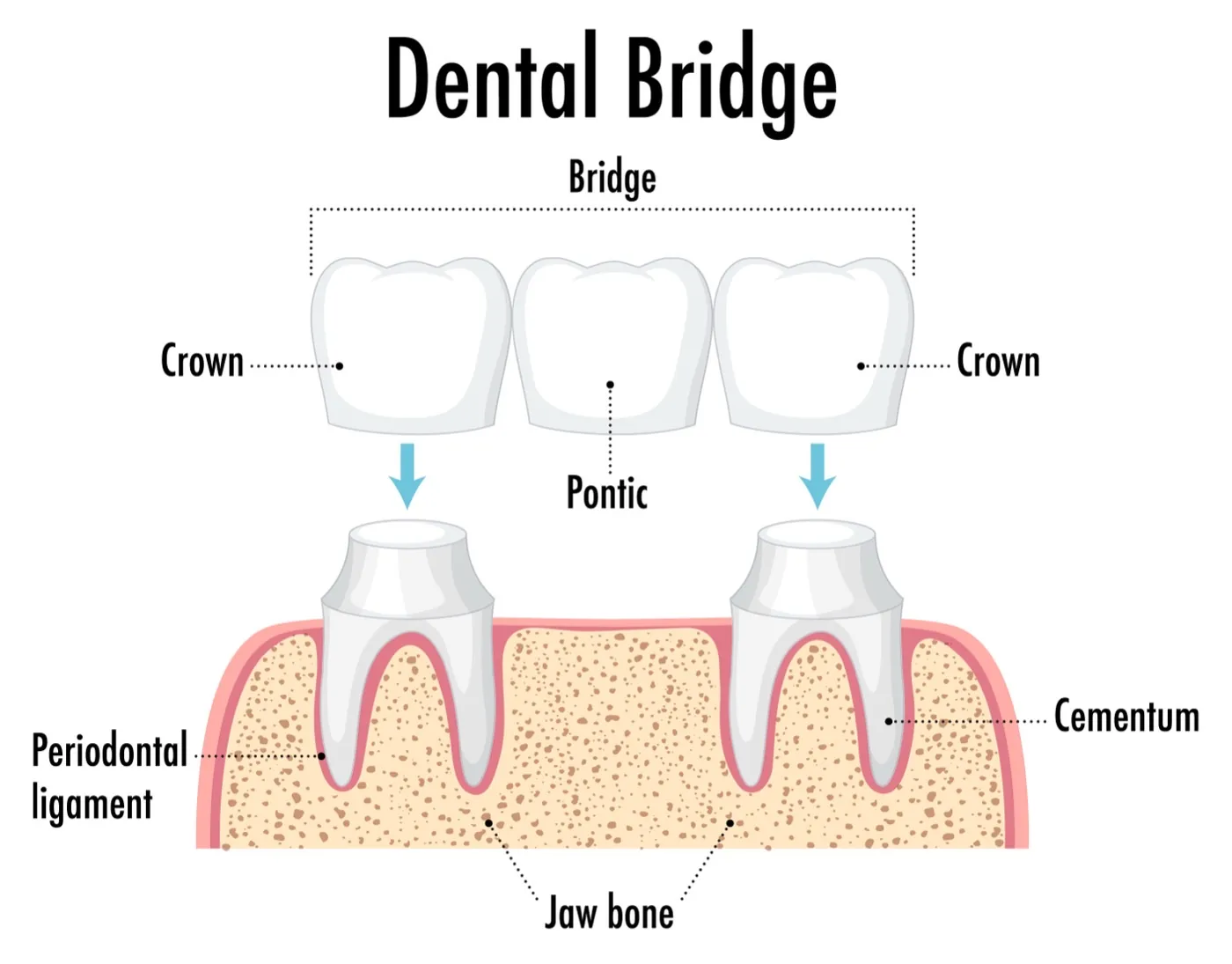
A dental bridge replaces one or more missing teeth. The Ontario Dental Association (ODA) describes it as false teeth held in place by the neighbouring teeth: a crown on each anchoring tooth, with the false tooth in the centre. That is the traditional bridge; other types are described below.
The ODA describes a bridge attached to your natural teeth as a non-surgical option. A bridge is also fixed: as the Canadian Dental Association (CDA) explains, you cannot take it out yourself. It is held either by your own teeth on each side of the gap or by dental implants, which are placed surgically in the jawbone.
If you have lost a tooth and want to know whether a bridge suits you, contact us to book a visit.
Why replace a missing tooth?
The ODA recommends replacing a missing tooth and gives four reasons: proper chewing, keeping other teeth from shifting, keeping the jawbone level at that spot, and appearance. These reasons apply to replacing teeth in general, not to any one method.
When teeth are missing, the other teeth may shift, which the ODA says can make teeth harder to clean and raise the risk of gum disease and cavities. Its note about shifting after an extraction does not apply to a wisdom tooth.
What types of bridge are there?
Before any treatment, the dentist reviews your medical history and symptoms and examines your mouth. The CDA says the type of bridge is recommended according to where the missing tooth is and the condition of your teeth, mouth and gums. The types it describes include:
A traditional bridge, for a gap with natural teeth on both sides. Those teeth are prepared for crowns, and the false tooth is joined to the two crowns.
A cantilever bridge, for a gap with healthy teeth on only one side.
A resin-bonded (Maryland) bridge, for missing front teeth. The false teeth are joined to metal bands cemented to the back of the natural teeth.
An implant bridge, anchored to dental implants placed surgically in the jawbone.
Ask us which of these types we provide and which, if any, would suit you.
What happens when you get a bridge?
The CDA sets out these steps for a traditional bridge held by natural teeth.
Preparing the teeth
The dentist files down the healthy tooth on each side of the gap. Impressions (moulds) are used to make a model of your teeth, from which the false tooth and the two crowns are made as one piece. A temporary bridge protects the exposed teeth and gums in the meantime.
Fitting the bridge
At the next visit, the dentist takes off the temporary bridge and cements the crowns of the finished bridge to the two prepared teeth.
How many visits does a bridge take?
The CDA's description involves two visits, one to prepare the teeth and one to fit the bridge. Treatment plans differ from person to person, so ask your dentist what yours involves.
What about freezing and dental anxiety?
Freezing is the everyday word for local anaesthetic. A traditional bridge involves preparing the teeth beside the gap for crowns, and the ODA says a tooth being prepared for a crown is frozen first, then filed down.
If your tolerance for pain is low even with local anaesthetic, or you feel anxious, tell your dentist. The ODA suggests mentioning anxiety to the dentist or receptionist when you book and again when you arrive.
What are the trade-offs and risks of a bridge?
A traditional bridge means filing down the healthy teeth beside the gap. The CDA notes that for one missing tooth between two healthy teeth, a single implant can be an alternative that avoids this.
The ODA lists poorly fitted bridges among the risk factors for gum disease. Dentists quoted in its patient magazine add that crowns and bridgework do not whiten the way natural teeth do. If you also want whiter teeth, they suggest talking to your dentist about whitening before restorative work, so the new material can be matched to your whitened teeth.
Your dentist must discuss the risks of the proposed treatment with you before you agree to it, so ask which risks apply to you.
What are the alternatives to a bridge?
An implant is the surgical alternative. The ODA describes small metal posts placed in the jawbone as artificial roots, with the replacement tooth attached a few months later, once the implant has fused to the bone. A bone graft may also be needed after an extraction.
Dentures, full or partial, are made in a laboratory from measurements and an impression of your mouth. A partial denture can be taken out for cleaning and at night, and the CDA notes it may be used when nearby teeth are not strong enough to hold a bridge or when more than a few teeth are missing.
How do I look after a bridge?
Brush and floss a bridge every day; your dentist can show you how to use a floss threader under and around the false tooth. The ODA's patient magazine adds that super floss, which has a stiffer end, makes it easier to clean under a bridge, and that interdental (between-the-teeth) brushes suit people with bridges.
Regular dental visits and professional cleanings matter too. The ODA recommends seeing your dentist at least once a year, or more often if advised, and warns that biting ice can crack and break teeth or dental work.
When should I call the dentist?
If you have unexpected discomfort after a dental procedure, check with your dentist before taking any medication; health conditions and allergies can limit the options.
The ODA lists constant or severe pain in the mouth as a reason to call your dentist straight away, and suggests asking your dentist in advance what to do if you need care after hours.
The ODA also lists gums that bleed when you brush, or are red, swollen or tender, as warning signs of gum disease. If you notice them, call the clinic during opening hours to have them checked.
Who provides a bridge, and when is a specialist involved?
The CDA's description has your own dentist preparing the teeth and fitting the bridge.
Prosthodontics, a dental specialty recognized by the Royal College of Dental Surgeons of Ontario (RCDSO), is concerned with restoring natural teeth and replacing missing ones. If your treatment is complex, a dentist may refer you to a specialist, who usually works with both you and your general dentist. You can also contact a specialist directly.
How are fees for a bridge set?
Each Ontario dentist sets their own fees, which may be above or below the ODA's annual Suggested Fee Guide. A dentist who intends to charge more than the guide must tell you. Fees differ because no two mouths, treatments or office costs are the same.
A bridge needs work from a commercial dental laboratory, and the laboratory's charge is added to the dentist's fee at exactly the amount the laboratory charged the dentist. The RCDSO says an estimate should include laboratory and material costs where they apply, and that if the plan changes during treatment, the dentist should explain the extra cost and confirm you agree before going on.
If you have dental benefits, a predetermination shows what your plan covers and its limits, but it is not a promise that the treatment will be paid for.
What should I ask before agreeing to a bridge?
The RCDSO says you can and should ask questions until you fully understand the proposed treatment and its costs. The ODA suggests asking why it is recommended, whether there are alternatives, what happens if you refuse or delay it, and what you can do to maintain it.
The RCDSO encourages dentists to give a personalized treatment letter, so you can review the details at your own pace and seek a second opinion. A second opinion will probably mean paying for another examination and consultation.
Dental Bridges: common questions
A dental bridge is a fixed replacement for one or more missing teeth: false teeth held in place by the neighbouring teeth or by dental implants. The Ontario Dental Association describes two crowns on the anchoring teeth holding the false tooth between them, and calls a bridge attached to your natural teeth a non-surgical option. Unlike a removable partial denture, a bridge stays in place and you do not take it out yourself.
Your other teeth may move out of position. The Ontario Dental Association links that movement to teeth that are harder to keep clean and a higher chance of gum disease and cavities, and says that losing several teeth and struggling to chew could lead to digestive and nutritional problems. It excludes wisdom teeth from its warning about teeth shifting after an extraction.
The Canadian Dental Association describes two visits for a bridge held by natural teeth. At the first, the teeth on each side of the gap are filed down, impressions are taken and a temporary bridge goes on to protect them; at the second, the finished bridge is cemented in place.
Tell your dentist before treatment begins if you feel anxious, or if your tolerance for pain is low even with freezing (local anaesthetic). The Ontario Dental Association says talking with your dentist is the first step in dealing with dental anxiety. If you have unexpected discomfort afterwards, speak to your dentist before taking any medication.
There is no single answer: treatment is based on your own needs, and before you consent your dentist must explain the alternatives to what they propose. A bridge fixed to your natural teeth needs no surgery, while an implant is a post placed surgically in the jawbone. The Canadian Dental Association notes that a single implant spares the healthy teeth beside the gap from being filed down, and that a removable partial denture may be used instead when the neighbouring teeth cannot support a bridge or more than a few teeth are missing.
The Canadian Dental Association says a well-cared-for bridge should generally last about 10 years; that is a general figure, not a promise for any one bridge. Caring for it means brushing and flossing every day, including under the false tooth with a floss threader or a floss that has a stiffer end, along with regular dental visits and professional cleanings.
There is no single fee: Ontario dentists set their own fees based on factors such as the complexity of the treatment, the time it takes and the materials used, and estimates are rarely given without an examination. Dentists may use the Ontario Dental Association's Suggested Fee Guide as a reference, and must let you know if they plan to charge above it. Because a bridge needs commercial laboratory work, the laboratory's charge is passed on to you as well, at cost; you can ask for an estimate that covers both and submit it to your dental plan for a predetermination of benefits.
A general dentist can. In the Canadian Dental Association's description, the patient's own dentist prepares the teeth and places the bridge. If the treatment you need may be complex, a dentist may refer you to a dental specialist; the specialists who restore natural teeth and replace missing teeth are prosthodontists, and you can also contact a specialist on your own.
Visiting Ur Dental in North York
Ur Dental is at 6239 Bathurst Street, at Bathurst and Steeles. On-site parking is available.
Hours: Tuesday to Friday 10 a.m. to 6 p.m., Saturday and Sunday 9 a.m. to 5 p.m., closed Monday.
Sources
- Ontario Dental Association: Cosmetic Dentistry
- Ontario Dental Association: Tooth Loss
- Ontario Dental Association: Common Dental Procedures
- Ontario Dental Association: Dental Treatment Estimates
- Ontario Dental Association: Your Dental Team
- Ontario Dental Association: Dental Specialists
- Ontario Dental Association: Stress and Anxiety
- Ontario Dental Association: Gum Disease
- Ontario Dental Association: Dental Emergencies
- Ontario Dental Association: General Dental Examination
- Ontario Dental Association: Dental Costs Explained
- Ontario Dental Association: Commercial Laboratory Charges
- Ontario Dental Association: Dental Benefits Explained
- Ontario Dental Association: YourOralHealth.ca magazine, Spring/Summer 2019
- Ontario Dental Association: YourOralHealth.ca magazine, Fall/Winter 2016-17
- Ontario Dental Association: YourOralHealth.ca magazine, Summer/Fall 2017
- Ontario Dental Association: YourOralHealth.ca magazine, Winter 2018
- Royal College of Dental Surgeons of Ontario: Fees & Charges
- Royal College of Dental Surgeons of Ontario: Information on Consent to Treatment
- Royal College of Dental Surgeons of Ontario: Use of qualifications, titles, and designations
- Canadian Dental Association: Bridges
- Canadian Dental Association: Dentures
Clinical information last reviewed October 9, 2026